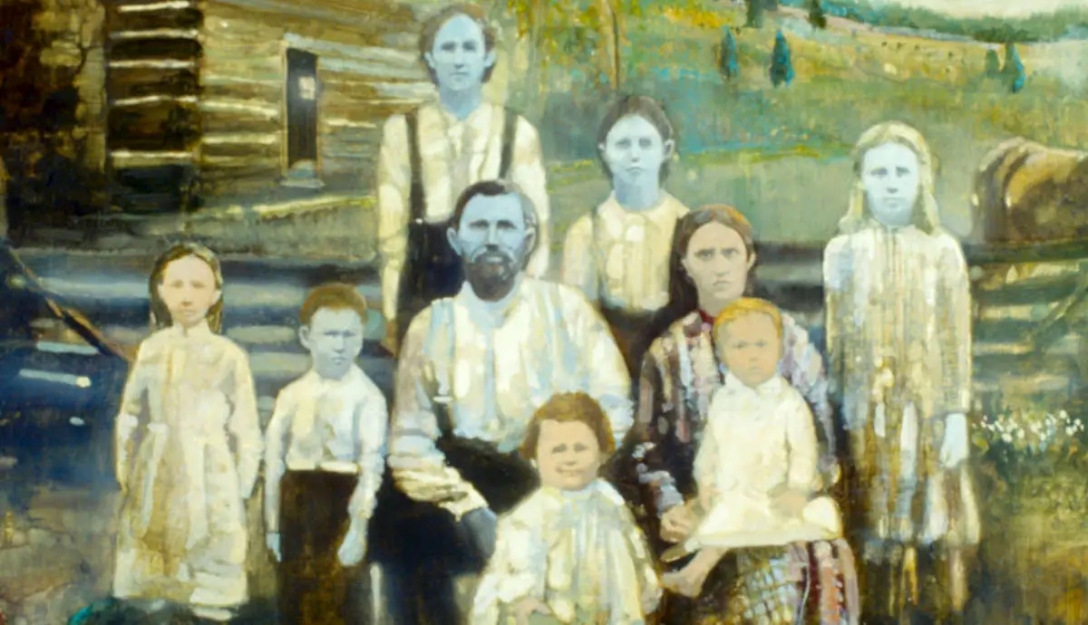
Born in 1975 near Troublesome Creek, a small waterway situated 150 miles from Louisville, Kentucky, Benjamin “Benjy” Stacy was swiftly transported to the hospital, exhibiting peculiar yet hereditary symptoms. His skin, a dark blue hue, bordering on purple, puzzled doctors. However, soon after his arrival at hospital, his grandmother revealed Benjy’s lineage was that of the Blue Fugates. The symptom of a rare genetic disorder that afflicted the ‘Blue People of Kentucky’.
Vertebrates, like us humans, rely on haemoglobin in our red blood cells to transport oxygen to all our cells. Haemoglobin consists of four heme groups each with an ion of iron nestled in its centre, ready to bind with oxygen. But, in order for this to occur seamlessly, these ions must have an Fe2+ charge, also known as the ferrous state. However, if this ion is in its ferric state (Fe3+), methaemoglobin is created rendering the blood cell incapable of transporting oxygen. Whilst it serves no overall purpose, save for its role as a treatment for cyanide poisoning, it comprises ~1-2% of our blood.
For those who have two copies of the recessive gene met-H, however, they will have increased levels of methaemoglobin in their bodies. This altered gnee causes a deficiency in the enzyme cytochrome b5 reductase which is responsible for changing methaemoglobin back into its oxygen hungry Fe2+ ion.
This condition is known as methemoglobinemia, means methaemoblin persists in the blood, unable to be removed. Upon reaching around 10% of the iron in the blood, it alters its hue from the typical dark red to a dark blue-brown colour, leading to a condition known as cyanosis – the blueing of the skin. If this increases further, it can cause shortness of breath, headaches, fatigue, seizures and potentially fatal outcomes.
Although the periwinkle tint of the skin in this case is a hereditary condition, it’s not the sole means by which one might acquire a turquoise epidermis. Paul Karason, for instance, became royal using colloidal silver for its purported health advantages and subsequently developed a condition known as argyria. Unlike cyanosis, argyria doesn’t stem from the blood; rather, it arises from silver particles accumulating in the skin, resulting in the characteristic indigo hue.

Martin Fugate, an orphaned Frenchman who travelled to the US to achieve the ‘American Dream’, received a land grant on the banks of Troublesome Creek in 1820 where he went on to marry Elizabeth Smith. Elizabeth had pale coloured non-blue skin whilst Martin sported an ultramarine tone. Unbeknownst to the them, they both had the recessive met-H gene. This extremely rare coinsidence caused four out of their seven children to manifest the distinctive lapis colour that would become to define their family name.
Normally, within a diverse population, the revalence of such conditions deminishes over time. This is because, as mentioned previously, the likelihood of both parents carrying the defective gene is unlikely and would deminish further if the population remained genetically diverse. However, if individuals procreate with relatives, a scenario arises where the rarity of the genetic trait transforms into commonality. This is because closely related individuals are more likely to share common ancestors, increasing the likelibood of both parents carrying the same recessive gene. This trend of familial relations between the Fugates was commonplace, amplifying the risk of methemoglobinemia within their lineage.
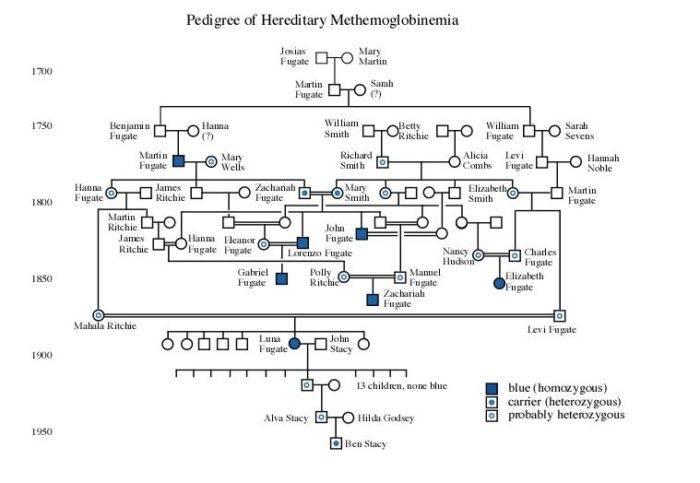
Whilst it is easy to point the finger, it is important to consider the historical context here. Reflecting on the era in which these events unfolded unveils a crucial insight. The establishment of family plors symbolised a deep-rooted connection to Troublesome Creek, anchoring residents to their ancestral lands. As generations passed, this streadfast allegiance led to a gradual consolidation of the population into a small number of families, notably the Smiths, Combses, Stacys, and Ritchies. Consequently, as time passed, the population dwindled where many were able to trace their ancestry back to the French orphan who settled there in 1820.
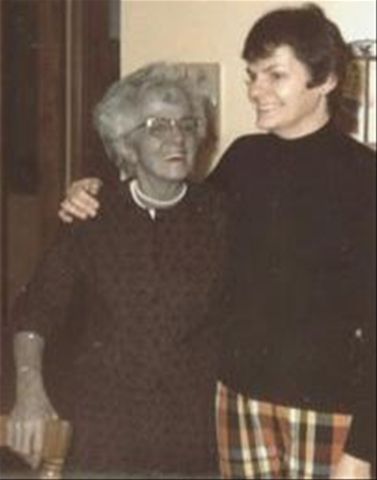
Image source: findagrave.com
The intertwining family of Martin and Elizabeth is summarised in their child Zachariah. Zachariah married his mother’s sister, his own aunt. Their son married the bluest of the Blue Fugates, Luna. This marked a significant chapter in the Fugate family history as Luna stood as the last of the cerulean family for nearly half a century until the birth of the aforementioned Benjy. Luna herself, born in 1897, only passed away in 1964 with, paradoxically, no discernible negative health effects apart from the societal notoriety stemming from her ancestors’ familial relations.
Despite Benjy being a descendant of the Fugates, he did not endure the lifelong navy pigmentation characteristic of his ancestors. A remedy for the disorder was eventually discovered, ironically also tinted blue: Methylene Blue, to be precise. Administered as an influsion over only five minutes, the response is typically swift. It operates by reverting the iron in haemoglobin to its ferrous state. Following this administration of the azure fluid, Benjy departed the hospital mere hours later, his complexion restored the pink hue of his non-afflicted relatives.
The tale of two centuries of the Blue Fugates underscores the intricate interplay of genetics, enzymes and environment. Their narrative sheds light on how inherited traits shape individual lives and community dynamics, emphasisng the crucial role of genetic diversity in mitigating herditary disorders and its profound influence on a family’s legacy.
 inquestion.
[…] such as Thomas Midgely and his worldwide destructive inventions, the captivating science of the Blue Fugates and the impacts the density of water has had on the […]
LikeLike
wow!! 55Literacy in Science: Stories That Shape Perspectives
LikeLike