
Japan is unique. Yes, it has its odd penchant for vending machines or futuristic capsule hotels, but Japan holds a more sombre record: the only country to have nuclear bombs deployed on its soil during wartime.
In the years since the Potsdam Declaration, the Japanese may have believed they were at the end of nuclear weapons incidents at the hands of the Americans, but less than a decade since the Japanese surrender in September 1945, there was another first in Japan. The world’s first death from a hydrogen bomb.
Toward the end of the Second World War, the US had taken control of the Marshall Islands from the Japanese and later designated it the ‘Pacific Proving Ground’. The US continued to occupy the Marshall Islands for another 40 years and during this time detonated over 150 nuclear weapons in the 7,800,000 km2 area – with 20 occurring around the picturesque dreamscape known as Bikini Atoll.
In the early days of the Pacific Proving Ground, Dr John C. Clark was a renowned ‘triggerman’ of the US Atomic Energy Commission, having detonated numerous nuclear weapons throughout his career. On the 1st of March 1954, Clark began, what he believed, to be an ordinary, run-of-the-mill nuclear weapons test. Located around 20 miles away from Bikini Atoll, on the islet of Enyu in a reinforced concrete bunker, the stage was set. At 6:45am local time, the call from the nearby USS Estes came in declaring “it is a good one”. The detonation was a success.
At 1,000 times as powerful as the Nagasaki and Hiroshima nuclear weapons dropped on Japan, these were not only a feat of engineering, but a glimpse into the ultimate destructive power the human race has ever developed.
Whilst Clark and his team were initially elated at the successful explosion, the mood within the bunker slowly changed as they noticed their Geiger counters had jumped from 8 milliroentgens per hour to 40. This was not particularly life-threatening, but considering the bunker was 20 miles from the detonation site, it was evident something was wrong. A few hours later, the Geiger counter recorded exposure in the bunker almost 1000 times stronger.
The largest nuclear weapon ever tested by the US resulted in an explosion twice as powerful as predicted, spewing radiation far further than the pre-declared danger zone. In fact, it spread over an area 450km wide and placed the lives of almost 20,000 people in mortal danger.
Shortly after the detonation, inhabitants of a nearby atoll, Rongelap, began to notice ‘snow’ falling from the sky. Being an uncommon sight in the middle of the pacific ocean, the residents of the island played in the atmospheric phenomenon not knowing they were actually frolicking in deadly radioactive fallout created from blasted sand and coral. 48 hours after the detonation, the residents began to display symptoms of acute radiation sickness. Only then were they evacuated by the US Navy.
On the fishing boat Daigo Fukuryū Maru (Lucky Dragon 5), now situated inside the now enlarged danger zone almost 100 km from the initial blast site. The fishermen described a “sunset in the west” and a short time later came a powerful shockwave which nearly capsized their boat. Finally, came the falling of the same radioactive ‘snow’ that affected those within the Pacific Proving Ground.
Since the manmade sunrise and subsequent shockwave, the fishermen began to draw in their lines but this process took around 6 hours. The radioactive coral that descended was a curiosity the fishermen picked up with their bare hands with one even tasting it, describing it as “gritty, but with no taste”. The fishermen unknowingly began to succumb to acute radiation sickness and possible radiation burns on their skin as they headed home. The men aboard the Daigo Fukuryū Maru were not alone, with almost 1,000 fishing boats falling with the new, and enlarged, danger zone all now being at risk.
Arriving in the Japanese port town of Yaizu, doctors instantly suspected radiation sickness. In their experience of dealing with people affected by the radiation from the Hiroshima and Nagasaki attacks, known as the hibakusha, characteristic nausea, low white blood cell count, bleeding gums and skin burns were all the telltale signs of acute radiation sickness. The only conclusion was that these fishermen had suffered a nuclear attack.
The captain moved the boat up to an isolated port before being rushed to the National Tokyo First Hospital for intensive tests and numerous blood transfusions. Panic began to ensue in Yizu with individuals obtaining their own personal Geiger counters to measure the radiation of tuna that may have become contaminated with radiation. A belief began to arise that the radioactivity was contagious, resulting in tons of perfectly good fish being wasted – decimating the local food market so heavily reliant on fish.
I pray that I am the last victim of an atomic or hydrogen bomb
Aikichi Kuboyama
News of the possible nuclear attack began to spread throughout Japan. The US did little to calm the situation by declaring the Daigo Fukuryū Maru to have been in a restricted area and therefore must have been a “red spy” mission on behalf of the Soviets. Intense negotiations ensued with the Americans even refusing to give information as to the composition of the fallout due to threats to “US national security”. In reality, the US knew that if they disclosed the radioactive data, it would confirm Soviet suspicions that the US had successfully developed a true thermonuclear weapon – something they wouldn’t achieve until the following year
In the months after the nuclear detonation, the ship’s radio chief, Aikichi Kuboyama, the condition began to worsen. He was diagnosed with aplastic anaemia and just 6 months after the explosion, on September 23rd, he passed away. On his deathbed he said “I pray that I am the last victim of an atomic or hydrogen bomb”, he was just 40 years old.
As some of his crewmates began to be discharged from the hospital, many of them lived their lives in secret due to the belief radiation was contagious. Many moved away to new places and started their life afresh. The last survivor of the Daigo Fukuryū Maru, Matashichi Oishi, passed away in March 2021 at the age of 87. Some suggest that he was the luckiest man on a boat named Lucky, but many of his children were stillborn and he himself developed liver cancer years after the incident – something he always attributed to the events of 1954.
After the Castle Bravo disaster, the US agreed to pay the Japanese $15 million to end the disagreement. They did not, however, admit responsibility for the disaster but gave the settlement out of “the goodness of their heart”.
The Pacific Proving Ground today is a ravaged land that will remain pockmarked from the scourge of nuclear weapons testing for centuries to come. The lasting effect of the US’s nuclear weapons testing has rendered some islands uninhabitable. The area poses major economical and environmental issues to this day, with the US forking out almost $800 million in clean-up efforts and compensation since 1990 alone.
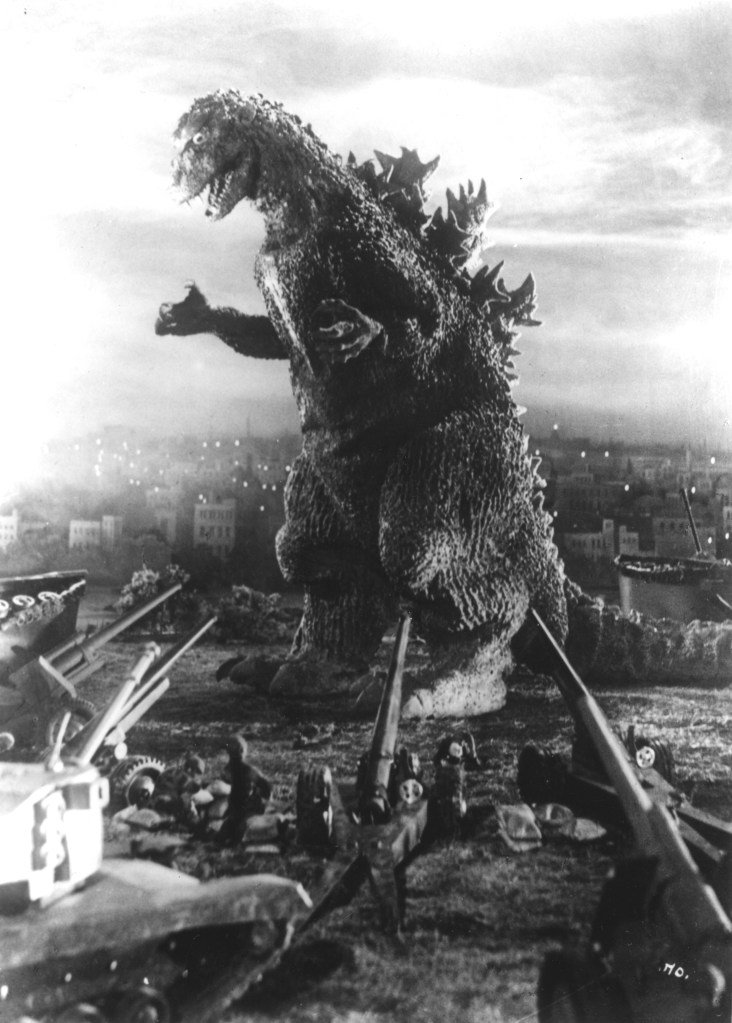
The bombings of Hiroshima and Nagasaki during World War II triggered antinuclear sentiment, and the Lucky Dragon 5 disaster did nothing but agitate it. Numerous films were made regarding the incident, including the 1954 film Gojira, known as Godzilla in the West, with the monster being an allegory for a nuclear holocaust.
Ishirō Honda, the movie’s director, was quoted as saying “If Godzilla had been a dinosaur or some other animal, he would have been killed by just one cannonball. But if he were equal to an atomic bomb, we wouldn’t know what to do. So, I took the characteristics of an atomic bomb and applied them to Godzilla.”
Kuboyama’s wish to be the last person to die at the hands of a nuclear bomb was unfortunately never granted. It is estimated that since World War II, 150,000 deaths can be attributed to atmospheric weapons testing. In reality, we will never truly know how damaging nuclear weapons have been to our health and our planet in the long term.
The Japanese have been forced to learn from the experiments of others and despite their technological superiority and weapons advancements, have maintained the Three Non-Nuclear Principles of no possession, no development, and no hosting of any nuclear weapons. Their wish for peace is marked with the yearly ringing of the Japanese Peace Bell at the UN headquarters in New York on September 21st, the International Day of Peace.
For the many that have been lost by the development and deployment of nuclear weapons, one can take solace in that one day, someone will be writing an article about the last person to die at the hands of a nuclear weapon and then, and possibly only then, we may truly be in a world of peace.
 inquestion.
[…] first practical man-made fusion device of any kind was the Castle Bravo test in 1954, but this was dangerously unwieldy. To make this an energy that can be harnessed for the masses, it was clear that control was what […]
LikeLike