As a science teacher, one of the most common phrases I always say is “UNITS”. Every science teacher has that one line that they always use that usually goes something like:
“50 what? 50 bananas? 50 apples? 50 joules? Yes, 50 joules!”
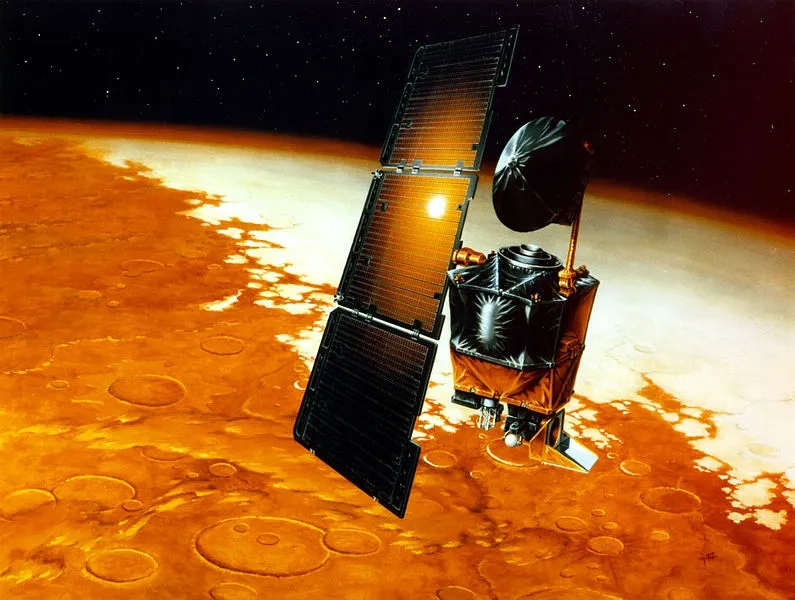
In an aim to reduce how much I have to say this line, I recently took the time to tell the story of the time NASA lost the $150 million ($250 million in 2022 dollars) Mars Climate Orbiter due to a unit error.
Under the Mars Surveyor Programme, the development of the orbiter began in 1996 as an attempt to reduce costs for scientific interplanetary missions (the irony, I know). The orbiter was around 2 meters tall, 1.5 meters wide and 2 meters deep and contained instruments to determine the distribution of water on Mars, determine its weather, and look for evidence of past climate change.
On the 11th of December 1998, the orbiter was launched from Cape Canaveral, Florida on board a Delta II rocket beginning its 9-month journey to Mars. The launch went off without a hitch and it wasn’t until September 23rd, during an orbital manoeuvre, that the orbiter lost radio contact and was never re-established. The orbiter was assumed to have crashed into the surface of Mars – destroying it completely.

The cause of the loss was due to the software being used was due to the Jet Propulsion Laboratory using the metric system of millimetres and meters when operating the orbiter in space, but its manufacturer and supplier of acceleration data, Lockheed Martin, used the US customary unit system of inches, feet, and pounds.
The onus of the error was placed on the Jet Propulsion Lab as they didn’t notice the error. The software gave results in pound-force seconds but the JPL expected these to be in newton-seconds. This caused a large discrepancy between the desired and actual altitude. The intended orbit altitude was supposed to be around 140-150 kilometres, but the error causes its altitude to actually be 57 kilometres and due to the stresses of the atmosphere, the orbiter began is disintegrate and fall down to the surface of Mars.

Whilst this is a short story, I have continued to make reference to it when a pupil does not include units in their answers. I first introduced this to my Year 10 pupils, but I think this is a fun (and expensive) story to introduce the idea of units and will be using it with my Year 7 pupils next year when first playing around with some physics calculations.
I can finally stop asking about bananas and now start saying: “have you got a spare $150 million to not put those units in?”. They laugh when I say it, but I do wonder how long that will last…
 inquestion.
[…] of DNA is a story many collect on their way when learning their curriculum; or the failure of NASA’s Mars Climate Orbiter when discussing the importance of […]
LikeLike