
In thirty years’ time, the world will be powered by nuclear fusion. Thus creating cheap and easy energy for all and releasing us from the shackles of pollution, once and for all.
This has been a line that has been repeated multiple times over the years. This phenomenon even has a name – the Thirty-Year Problem. Harnessing the power of stars has, quite predictably, not been easy. Ever since Arthur Eddington first described nuclear fusion in the 1920s, we have been looking to harness its potential.
Thirty years later, on a small island in a lake in Argentina, the world would be sold fusion in a bottle.

Before the 1920s, the might of our celestial parent had been a mystery. It wasn’t until Arthur Eddington that we even began to understand the process. In his paper, The Internal Constitution of the Stars, he theorised there was a direct conversion of hydrogen into helium happening in stars. By using Einstein’s E=mc2, he suggested the discrepancy between the masses of a helium nucleus and hydrogen nuclei could be the source of the energy used to fuel stars.
The first practical man-made fusion device of any kind was the Castle Bravo test in 1954, but this was dangerously unwieldy. To make this an energy that can be harnessed for the masses, it was clear that control was what was needed, and there was one who was willing to offer it. In a bottle.

Ronald Richter was an Austrian-born, Argentine citizen who had worked in Germany, the UK and France throughout his career. He worked with German physicists Manfred von Ardenne and Max Steenbeck to build one of the first particle accelerators. Later, he worked with Kurt Tank, the engineer who was responsible for numerous aircraft of the German Luftwaffe.
It would be Tank who would create the avenues for Richter to begin a career in ‘New Argentina’ – a concept thought up by the then Argentine dictator, Juan Perón. Richter had dreams of nuclear-powered aircraft using the expertise he obtained working in the German nuclear program, and Perón jumped on the chance to develop his own program.
Impressed by pitches from Richter, Perón gave 60 million pesos (around $300 million in 2022 USD) to develop his nuclear aspirations and made Richter the sole researcher. After scouting for potential sites to begin his research, Richter settled on Huemul Island – an isolated island in the Nahuel Huapi Lake, and began building.
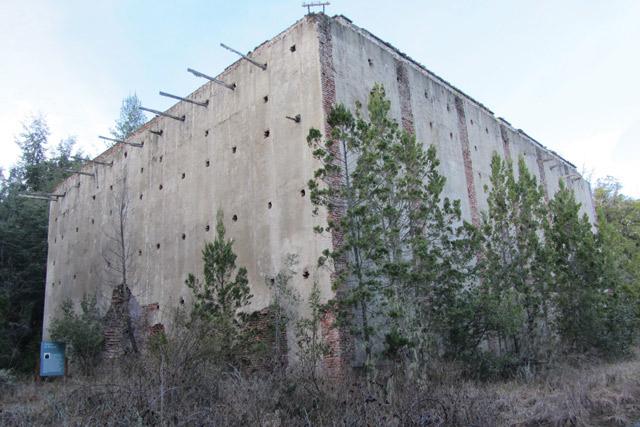
On 16th February 1951, it happened. Richter had measured an increase in temperature within his experimental reactor and concluded, falsely, that this increase in energy was created by the fusion of the tritium nuclei, but, and this was the key point, without an explosion.
Richter repeated the experiment for the National Atomic Energy Commission of Argentina who then later claimed to have witnessed the world’s first thermonuclear reaction. When members of his own team began to err on the side of caution and rerun the experiments again, believing there may have been issues with measuring, Richter wielded his power and had the reactor destroyed.
Perón, on the 24th March 1951, held a press conference and declared: “thermonuclear experiments were carried out under conditions of control on a technical scale“. This announcement came as an energy shortage was occurring in the country and to further embolden the public, he described a utopian future whereby energy “would be sold in milk bottles“. Richter was rewarded for his efforts, receiving an honorary doctorate from the University of Buenos Aires and the Medal of Peronist Loyalty – the highest award of the regime.
The international community responded quickly, calling the Huemul Island project a hoax. Numerous scientists in Argentina tried, to understand the ramblings of Richter when they were unable to wrangle his thoughts, they were met with a barrage of insults from Richter.
Perón began to get impatient and formed a committee the following year to determine whether the work on Huemen Island should come to a halt. They were to report directly to him. They tried to reproduce, again and again, the thermonuclear reaction. In September 1952, they reported to Perón that the temperature was far too low to produce a reaction, and had therefore never occurred saying “there is no serious scientific basis for the claims of Richter“. The dream of energy you could buy in milk bottles at the supermarket was quashed.
On the 22nd of November, the military entered the facility and found that many of Richter’s team’s instruments were not even connected. The Huemul Project was a hoax and Perón closed the facilities at Heumen and a media blackout on the issue began.
In the years since the events on Huemul Island, Richter was placed under house arrest in the capital until the fall of Perón. The following government jailed Richter for fraud and after a brief stint in Libya, nothing more was heard from him.

Ironically, the events on Huemul occurred thirty years after its discovery. It has set a precedent in the realm of nuclear physics, that the power of the sun will forever be thirty years away. In 1991, the Joint European Torus (JET) located in Oxfordshire, UK, achieved the world’s first controlled release of fusion power. Almost on cue, thirty years later, in 2021, the first fusion reaction to release more energy than it took in occurred.
The term ‘Thirty Year Problem’ comes from the belief that with enough money and expertise, we could have the power of stars powering our devices in as little as thirty years. In reality, it is important for governments to not have all their eggs in one basket and therefore diversify their energy investments. As we learn more and more about how to harness this energy, more challenges arise, and more challenges mean more money and more time.
The Huemul Project hoax shows one thing. Throwing money at a problem will not always make it happen. Science cannot provide the world with unlimited energy in a bunker on an island in the middle of an isolated lake – it will be provided by working together and by standing on the shoulder of those scientists that came before us.
 inquestion.